
















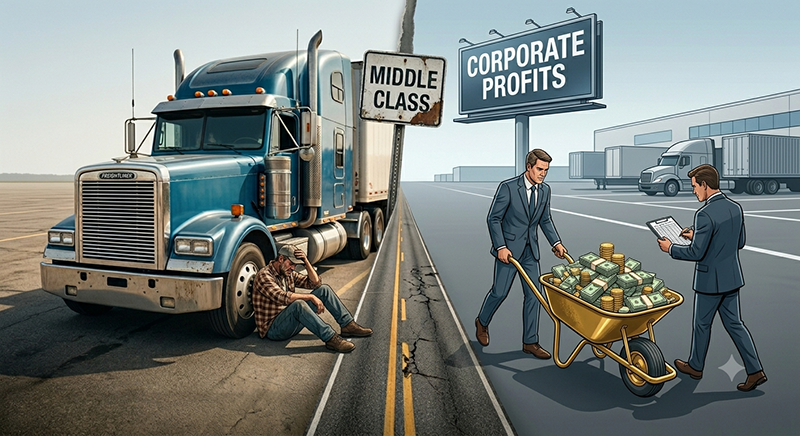
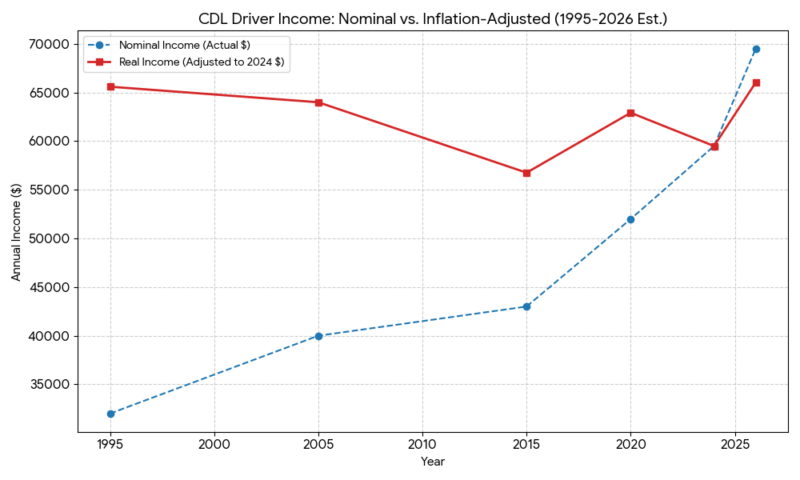
The career of the trucker—once a stable, middle-class profession—has been stripped of its former stature over the last 30 years. A driver making $32,000 in 1995 earned the inflation-adjusted equivalent of roughly $65,000 today. This means that for much of the last three decades, real wages for drivers remained stagnant or even slightly declined in purchasing power, until the “capacity crunch” of 2021–2022 forced a massive, industry-wide pay hike. During this post-pandemic recovery, spot market rates skyrocketed, leading to record-high profits for small fleets and owner-operators. However, by 2024–2026, the market had “cooled,” and many of those record profits returned to historical averages.
By comparison, the industry’s gross revenues have nearly tripled since 1995, climbing from $345 billion to over $900 billion. While carrier net profit margins have fluctuated between 5% and 8%, drivers’ wages have remained flat. Furthermore, large buyouts and corporate acquisitions across the industry have left many professional drivers with reduced pay, restructured benefits, or even unemployment.
The recent acquisition of FirstFleet by Werner Enterprises highlights these disturbing trends. The $250 million buyout—a cash transaction by an employer often cited for lower driver compensation—catapulted Werner into the ranks of the top five largest carriers in the United States. Mega-carriers like Werner have thrived, as having a quarter-billion dollars in liquid capital suggests, while the drivers themselves remain financially stuck in 1995.
Industry Financial Trends (1995–2024)
| Year | Avg. CDL Driver Income (Approx.) | Industry Gross Revenue | Typical Net Profit Margin |
| 1995 | ~$32,000 | ~$345 Billion | 3% – 5% |
| 2005 | ~$40,000 | ~$580 Billion | 4% – 6% |
| 2015 | ~$43,000 | ~$726 Billion | 2% – 4% |
| 2020 | ~$52,000 | ~$732 Billion | 2% – 5% |
| 2024 | ~$59,500 | ~$906 Billion | 3% – 8% |
The growing reliance on reciprocity CDL holders and undocumented drivers—alongside trucking firms exploiting gaps in border enforcement—has finally drawn public scrutiny. News stories of illicit trucking outfits using fake DOT numbers and placing unqualified drivers on the road with dire consequences have become a daily occurrence. Although American truckers have recognized this problem for years, their warnings have long fallen on deaf ears.
A potential turning point lies in stricter border enforcement and the implementation of existing immigration laws, coupled with targeted operations by the FMCSA and DOT to remove dangerous operators from our highways. Furthermore, the Supreme Court recently dealt a major blow to the status quo by allowing plaintiffs to pursue claims against freight brokers who hire unsafe trucking companies with troubling safety records. The effects of this ruling were immediate; across the country, illicit carriers now sit motionless in depots and shipping yards as brokers refuse to book them. The message is clear, and the true villain of this story is being unmasked: the industry itself.
Though I am pragmatic and usually protect myself from disappointment, I cannot help but feel optimistic. For years, drivers have pleaded for an accounting of the transportation industry’s greed, its disregard for the American trucker, and its violations of federal law. Executives have stood on the backs of the brothers and sisters who travel the highways and byways of this country, enriching themselves while treating the workforce with disdain. It is far overdue for federal and state governments to defend the very people who serve as the lifeblood of our economy.