



When I was a kid, my grandfather never called me by my name. I was “buddy,” always, and so he became Buddy to me. He had a chair in the living room, and from that chair he fought a hundred bouts with me. I’d strap on a pair of boxing gloves, he’d put on his, and we’d spar while he never once got up. He didn’t need to. I was six, and I was losing every round. He died that same year, so what I have of him is small: the gloves, the chair, and that word, buddy. For a long time that was the whole picture. Then I learned who he was before he was Buddy.
He was 2nd Lt. Stanley M. Johnson of Port Allegany, Pennsylvania, an airman in the U.S. Army Air Forces. Around August 22, 1944, his aircraft was shot down over France and he was captured. He spent the next nine months as a prisoner of war, until the end of hostilities in May 1945. He was awarded the Prisoner of War Medal. He went on to become a Major and eventually made his home in Brandon, Florida. I found his name in a story about Stalag Luft I, the prisoner-of-war camp at Barth, Germany, and the records filled in what I never knew.
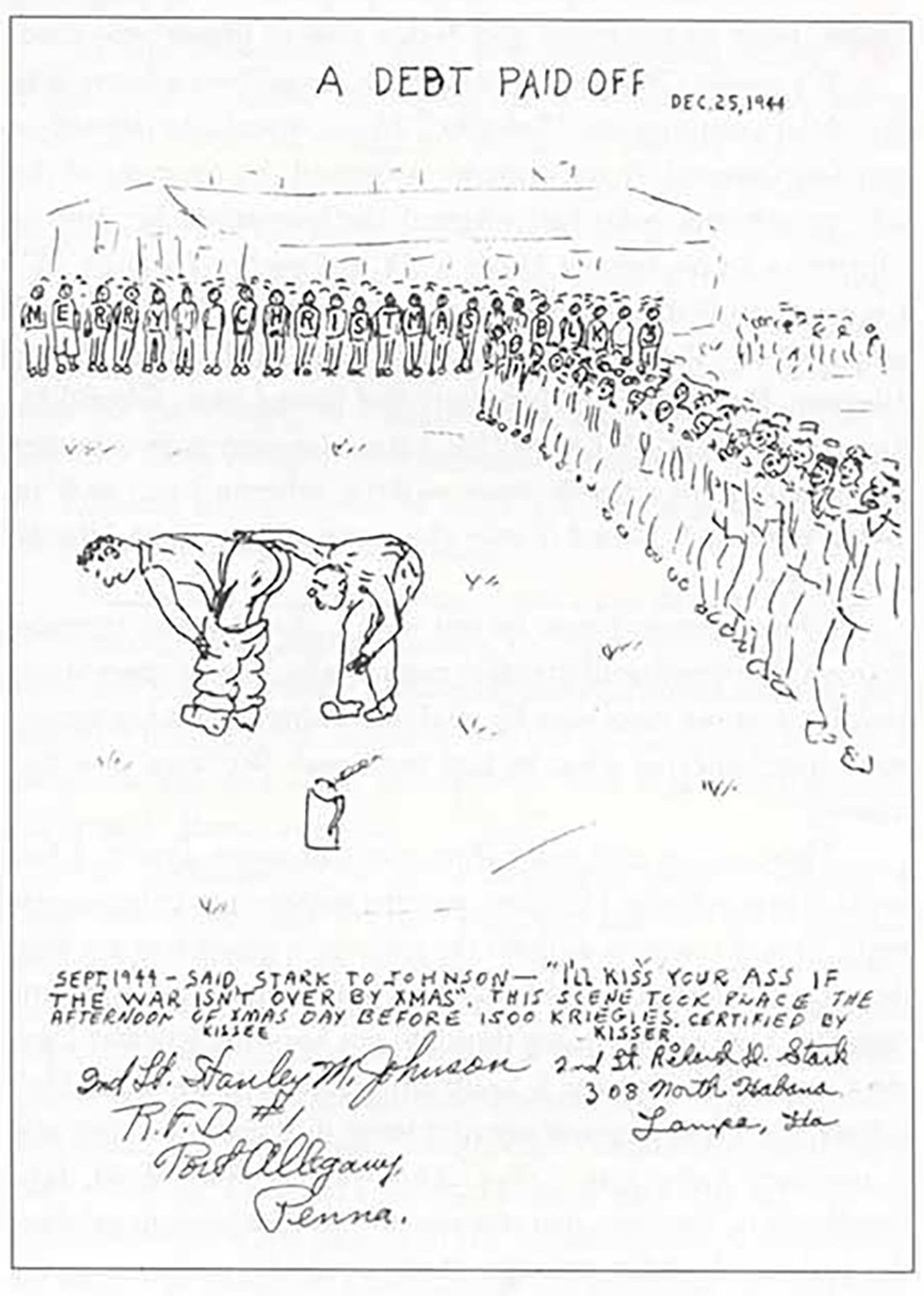
Barth held roughly ten thousand downed Allied airmen, split into compounds. The cold, the hunger, the lice and the boredom were constant. The men also had each other, and each new batch of prisoners brought fresh news. That fall the news was good: more bombers overhead, the Russians advancing in the east, the Allies pushing in the west. Talk turned to being home by Christmas, but not everyone believed it. Just weeks after he was captured, my grandfather got into an argument with a fellow prisoner, 2nd Lt. Richard D. Stark of Tampa, Florida. According to Mozart Kaufman, who was at Barth and wrote about it in his memoir Fighter Pilot: Aleutians to Normandy to Stalag Luft I, Stark said he’d kiss Stanley’s ass if the war wasn’t over by Christmas. The loser would pay up in front of the whole compound, right after roll call on Christmas morning.
Stark hadn’t counted on the Battle of the Bulge, which dragged the war into the new year. On Christmas morning 1944 the men stood in the snow under a bitter wind off the Baltic, and the German guards counted them as usual. When the count ended, nobody left. Earl Wasson, another Barth prisoner, wrote that the two men went into the barracks and came back with a bucket of soapy water and a towel. Then my grandfather stepped out in front of the formation and bent over, and Stark washed his backside and paid the debt. Kaufman says some fifteen hundred men cheered loudly enough to be heard in the other compounds. The camp’s German commander just stood there shaking his head.
Wasson’s account doesn’t end with the laughing. That evening the camp’s curfew was lifted for a Christmas service in the neighboring compound. The men walked out under a clear sky, with the northern lights flickering faintly overhead, and a single voice started “Silent Night.” Others joined in. The guards on their patrol routes stopped and listened, and some of them sang along in German. Wasson wrote that in a way the bet paid off for everyone, because that night they all slept in peace. They also swore they’d be home by the next Christmas, and they were.
I never got to ask my grandfather about any of this, but it fits the man I remember, who sat in a living room chair and took punches from a six-year-old with a grin on his face.
Rest easy, Buddy.